Tuesday, 17 September 2019

Demonstration of DRM reception


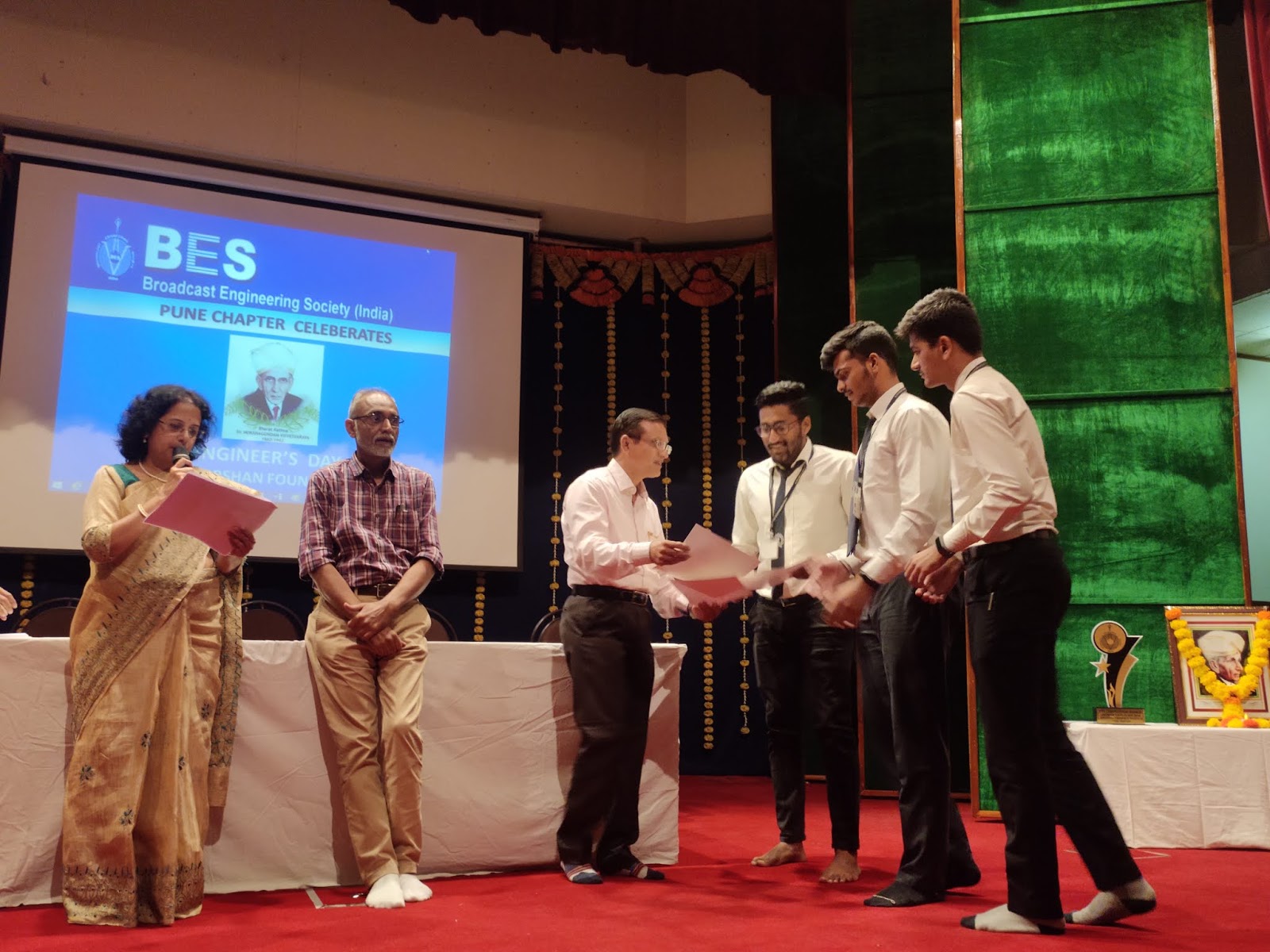
Broadcast engineering society (India) Pune chapter organized an event on Digital Broadcast Technologies in the World and PPT Competition on 15th September, 2019 to make the Engineers Day i. e. the Birth anniversary of Sir Mokshagundam Vishweshwaraiyya memorable at Auditorium All India Radio, Shivajinagar, Pune.

This session was followed by demonstration of DRM reception with inbuilt receivers in Maruti Nexa Vehicles which showcased the sound quality as compared to regular vehicle receivers. Smt. Dipti Kamlapurkar, General Manager, NEXA, had extended her co-operation and provided two Nexa vehicles i.e. Baleno and XL6 for demo

The demo in vehicles was followed by demo on domestic AVION make receiver.

Monday, 16 September 2019

Broadcast Engineers Society (I), Pune Chapter Celeberates Engineers Day on 15.09.2019.


Winner team


Runner up team
commemorate the Engineer’s Day , Broadcast Engineers Society (I), Pune Chapter organized an event at auditorium,All India Radio,Pune on 15th September 2019. A Technical Session was arranged on the subject “Digital Paradigm for Broadcast Media: Why?” by Shri Sharad Sadhu from Fraunhofer IIS, Germany and former Technical Head, Asia –Pacific Broadcasting Union, Malaysia. In the key note lecture, he described road map of digital broadcast ,digital radio services,digital television services, online mobile services. He gave information regarding DVB T2 system,ASTC DTV system, high performance TV and HDTV content creation. The audience was enriched with his informative and explanatory presentation.

The session was followed by a PPT presentation competition of Engineering students of E&TC stream of III /IV th year on the subjects Digital Radio Broadcasting - Features and Implementation in India, Digital Television Broadcasting- Features and Implementation in India and Software Defined Radio for Digital Radio Mondiale (DRM). Each college group consisting of 1 to 3 participants delivered a presentation of 5 min. Sixteen no of teams from various engineering colleges in and around Pune had participated in the competition. It was very tough and healthy competition. Trophies were awarded to Winner and the Runner up teams and certificate of participation was given to all participants in a enthusiastic and energetic atmosphere.


Shri Sharad Sadhu from Fraunhofer IIS, Germany and former Technical Head, Asia –Pacific Broadcasting Union, Malaysia, Chairman of BES Pune chapter and DDG(E),AIR Pune Shri Ashish Bhatnagar , Vice Chairman and Director Engineering,DDK Pune Shri Adhir Gadpale, Smt. Dipti Kamlapurkar, General Manager, NEXA, Vice Chairperson , ADE,AIR Pune Smt. Sangeeta Upadhye. Secretary, BES Pune Chapter,AE,AIR Pune Shri Ravindra Ranjekar and Treasurer,BES Pune Chapter, AE, DDK Pune , Shri Ashok Bhapkar graced the function. Anchoring of the programme was done by Smt.Jyoti Ranjekar,AIR Pune.

Demo of DRM Reception
Demo of DRM Reception in car

Demo of DRM Reception

In order to familiarize DRM transmission to the students, an demo of DRM reception was arranged by Smt.Chitrarekha Kulkarni,ADE,AIR Pune in the premises of All India Radio,Pune. DRM receivers in Maruti cars were also displayed. DRM reception quality was appreciated by students and faculties of Engineering colleges.


Thursday, 12 September 2019

Gospell to announce the DRM monitoring system and imminent release of portable DRM receiver


Gospell to announce the DRM monitoring system and imminent release of portable DRM receiver, and more Chengdu, China - Gospell, a leading supplier of pay TV system and equipment, satellite TV receiving products and microwave products, announces its product lineup for IBC 2019. The company will debut several new products featuring DRM (Digital Radio Mondiale) for both consumer and industry market, including:

• GR-22 - Portable DRM/AM/FM Receiver 

• GR-227 - DRM Car Adapter

• GR-301 - DRM/AM/FM Monitoring Receiver

• GR-310 - Audio Broadcast Monitoring Platform

• GR-AT3 - High Performance Active HF Antenna

GR-22 is a sleek and classy portable radio from Gospell, the contemporary stylistics of exterior design fits in your personal style, crystal clear DRM digital radio and AM/FM brings practicality and comfort to your daily enjoyment. Despite its pocket-size, it's a nifty full wave band receiver packed up in a tiny body that enables you to explore a wide variety of radio stations. It is also future-proofed for the next generation DRM-E technology. You have access to all the presets, station names, pro-gram details and even Journaline news on the easy to ready large LCD in a simple and intuitive way. Sleep timer set your radio to automatically switch off or wake up at your convenience. Listen to your favorite radio programs anywhere you like with 4 x AA batteries or connect it to mains.

GR-22 is a multi-functional radio that is flexible to your listen habits.

GR-22 will be available for purchase on Q2 2020.

GR-227 is a car digital radio adapter that utilizes most advanced interference and noise cancellation technology to receive digital radio in car while achieving the best audio quality and serve it to the car audio system over aux cable or by transmitting over an unused FM frequency. The receiver is fully compatible with DRM standard that is being deployed over the world, with its latest audio codec xHE-AAC. Based on software defined radio technology, GR-227 is ready for the emerging 

DRM-E standard that extends the DRM broadcast to FM band.

GR-301 is a high performance monitoring receiver that supports DRM, AM and FM. GR-301 supports the collection of key parameters of audio broadcasting, including SNR, MER, CRC, PSD, RF level, audio availability and service information. The collection and uploading of parameters meets DRM RSCI standards. The GR-301 can work independently or be deployed with other receivers to become a node in the service evaluation network. The GR-301 supports the xHE-AAC audio codec and is capable of handling the latest DRM-E standard through software upgrades.

GR-310 is a management platform designed for audio broadcast monitoring and receiver control pur-poses, it manages the geographically distributed GR-301 receivers. The platform can formulate receiving schedules, configure the receivers to perform receiving tasks, perform real-time

North Korea Resumes DRM Broadcasts


 A screenshot showing North Korea using a Dream DRM transmitter modulator. Credit: Hans Johnson

North Korea has returned to digital radio broadcasting after an absence of nearly two years. 

The latest Digital Radio Mondiale (DRM) shortwave transmissions began mid August. The country has had periodic DRM broadcasts for many years.

It appears unclear at this time however whether the current series of transmissions will soon end or be the start of a regular service.Thus far, all of the latest test transmissions have taken place on 3560 kHz, which is actually allocated for amateur radio use.

According to radio enthusiasts in the region, the signal has been clear and very audible.

In 2012, 2016, and 2017, the country’s international service, The Voice of Korea, trialed DRM.

Those tests involved a professional grade DRM modulator, which identified itself as being from the Engineering Research Center of Digital Audio and Video (ECDAV) at the Communications University of China in Beijing.

Pyongyang Broadcasting Station, a Korean-language service for Koreans living in China, Japan, and South Korea, has been carrying out these latest broadcasts, which appear to implement two DRM modulators.

The image shows North Korea using a professional DRM modulator made by BBEF. Photo credit: Hans Johnson

Based on settings and parameters, the first is the open-source, software-based Dream DRM transmitter.

Developed at Germany’s Darmstadt University some 15 years ago, technicians continue to tweak various parameters, such as bandwidth, as they test and learn about the system.

In spite of its age, the Dream DRM transmitter is compatible with any DRM receiver. North Korea could easily put on multiple DRM transmitters using this free system.

North Korean operators also appear to be using a professional grade DRM modulator, which is most likely from private Chinese manufacturer Beijing Broadcasting Equipment Factory (BBEF). BBEF is best known for selling North Korea a number of shortwave transmitters ranging in power from 20 to 150 kW in 2011.

A professional DRM modulator is more capable than Dream. But North Korea probably cannot manufacturer its own and a single modulator can easily cost many thousands of dollars.

A lot has changed since North Korea last aired DRM broadcasts two years ago. Broadcasters in China and Guam have started regular DRM services and Russia is set to begin a service for Russia Far East.

With so many DRM programs coming on air in the region, North Korea may finally decide to remain on the air for good using the digital radio standard.

Source :- https://www.radioworld.com/news-and-business/north-korea-resumes-drm-broadc asts

Tuesday, 3 September 2019

DRM webinars, on September the 3rd and 4th, have the overarching theme “DRM Emergency Warning Functionality – Saving Lives by integrating DRM into your National Warning Infrastructure”.


DRM webinars, on September the 3rd and 4th, have the overarching theme “DRM Emergency Warning Functionality – Saving Lives by integrating DRM into your National Warning Infrastructure”. Both sessions will be different and tackle this important function of DRM in an informative and engaging manner.

Each webinar session will be about 60 minutes and will start at 0130hrs GMT (9:30am KL/Sin/HK time – view in your timezone) each day and will be repeated at 0700hrs GMT of the same day (3:00pm KL/Sin/HK time – view in your timezone). Both sessions are identical. Please register and choose the session that suits you best.

Tuesday, 27 August 2019

DRM Highlights 'Smart Radio For All' at IBC 2019 .


Under the overarching theme "DRM – Smart Radio For All" the DRM Consortium has planned for two interactive sessions at this year’s IBC at Amsterdam to look at the practical implementation of DRM in various parts of the world. The focus of the sessions will be also on receivers and exciting receiver solutions.

The first event convened by the DRM Consortium is to be held on September 13 and will be hosted by Gospell under the title "The Gospell receiver – end to end solution for your needs".

The next day, the Consortium invites those interested to an interactive session, to be held at the Nautel booth, on the latest implementation of DRM across the world, its benefits and the questions that the standard can answer in 2019.

Ruxandra Obreja, the Consortium Chairman, says that: "The Consortium members want to update all those interested with the many developments of DRM across the globe. The progress made in Asia, the current demo In Russia, the possibilities in South Africa and Brazil are all worth highlighting and discussing. The interest and practical roll out of DRM demonstrates that DRM makes possible an immediate digital future for all broadcasters large or small, offering more programme choice to listeners, extra multimedia services, emergency warning functionality with increased energy savings, spectrum efficiency and full country coverage."

Other Consortium members attending the IBC exhibition are: BBC, Encompass Digital, Fraunhofer IIS, JVCKenwood, NXP, RFmondial, Sony.

Read more at: http://www.asiaradiotoday.com/news/drm-highlights-smart-radio-all-ibc-2019 © Radioinfo.com.au

Monday, 26 August 2019

Technology Updates - U.S.-Based Shortwave Broadcasters Eye Digital

DRM radio prototype from StarWaves

Given the NASB’s interest in low-cost DRM receivers, it was no coincidence that Johannes. Von Weyssenhoff was invited to speak at the annual meeting. Von Weyssenhoff said his StarWaves manufacturing firm (www.starwaves.de) has the technology, capability and existing prototypes to build DRM radios for $29 each, but only if the sale order is large enough to deliver economies of scale. (He also estimated $18 DRM modules could be built for installation in other radio models.)

“Twenty-nine dollars is doable at volumes staring at 30,000 receivers,” Von Weyssenhoff told Radio World. “Even smaller quantities would be possible at this price for very simple radios — for example, without graphics displays — but these would be special projects that had to be discussed individually. But even more advanced radios with Bluetooth or premium designs will be possible to offer at a reasonable price,” he said — as long as the sales orders was in the tens of thousands or more.

Given that India and China have committed to the DRM standard, there appears to be a mass-market for these receivers. But the problem for StarWaves is finding the money to build enough of them to drive per-unit costs down.

“In recent years I have tried to convince quite a number of potential investors but either I have not yet found the correct audience, or I was not yet able to communicate this great opportunity convincingly,” said Von Weyssenhoff. “You just have to imagine that alone in India, according to All India Radio, there is a demand of up to 150 million receivers within the next few years. This market could have been served with tons of receivers by now and big profits could have been made, but instead I had to grow the development in very small steps.”


Plug-in DRM module

The money StarWaves needs is not huge: “An amount of $150,000 or even $100,000 would certainly do wonders and enable us to start production within a few within a few weeks,” he said. “A commercial order of 10,000 receivers or more would have a similar effect.”

NASB’s members don’t have this kind of money available. Saddled with huge antenna farms and multiple power-devouring 50 kW to 500 kW transmitters, the commercial/religious shortwave broadcasting sector is tight for cash.

“Broadcasting DRM requires either a new transmitter or the modification of an existing transmitter,” said Kim Andrew Elliott, a retired Voice of America broadcaster and host of “Communications World” who has organized many demonstrations of DRM reception at the annual Winter Shortwave Listeners Fest going back to 2003.

“These days, many shortwave broadcasters are thinking about whether they should keep their existing shortwave transmitters on the air, rather than thinking about buying or modifying a transmitter.”

Their situation isn’t helped by the lack of audience measurements detailing SW’s far-flung listener base. Not only does a lack of SW ratings make it difficult to sell spots to advertisers, “but the squeaky, staticky sound of shortwave makes it hard for us to talk to the people at Coca-Cola, who fear that listeners will associate their product with inferior quality,” said Caudill.

The resulting conundrum is a classic chicken-and-egg dilemma. StarWaves and other DRM radio manufacturers don’t have the money to produce DRM radios in volumes that would make them cheap to buy.

Source:- https://www.radioworld.com/tech-and-gear/u-s-based-shortwave-broadcasters-eye-digital

Thursday, 22 August 2019

New Android based DRM decoding App


If you would like to lighten the load of your DRM reception hardware, you could off load the work of decoding with a new Android based DRM decoding App. 

'DRM30' FREE
https://play.google.com/store/apps/details?id=com.algorkorea.app.drm1

'DRM+' $1.99 
https://play.google.com/store/apps/details?id=com.algorkorea.app.drmplus

Although air coupling the demodulated DRM Audio between the receiver speaker / headphone and the microphone input of the Smartphone / Tablet will work to some degree. Likely ambient noise will be introduced causing the decoding to be less than ideal. Holding the smartphone microphone near the demodulated DRM output is a quick way to check the SDC. A direct cable or even a filtered line may be needed to decouple Phone / PC / Receiver noise for a solid MSC and audio decode.

If you use a headphone / microphone multi pole plug (like the diagram below), the decoded DRM audio will automatically route to the Headphone jack, so an Audio Switching App (many available on google play store) can be used to route audio to the main speaker of the phone.

Let us know if you use this in your tests... And how it works...

Source:-http://ktwrdrm.blogspot.com/2019/08/drm-decoding-app.html?m=1

Thursday, 1 August 2019

Silicon Labs introduces new hybrid software-defined radio automotive tuner supporting Digital Radio Mondiale


Silicon Labs enhances Si479xx automotive tuner family with SDR technology.

Silicon Labs has introduced new hybrid software-defined radio (SDR) tuners, expanding its portfolio to meet the growing need of automotive radio manufacturers to support all global digital radio standards with a common platform.

The Si479x7 devices are Silicon Labs’ first automotive radio tuners supporting the Digital Radio Mondiale (DRM) standard and are an extension of the company's family of Global Eagle and Dual Eagle AM/FM receivers and digital radio tuners.

Silicon Labs is also enhancing its Si4790x/5x/6x automotive tuners with a unique “SDR-friendly” technology, effectively transforming these devices into hybrid SDR tuners. Its hybrid SDR technology includes advanced DSP-based automotive features such as Maximal Ratio Combining (MRC), Digital Automatic Gain Control (AGC), Digital Radio Fast Detect and Dynamic Zero-IF (ZIF) I/Q. These features enable automotive radio manufacturers to support global digital radio standards with a common radio hardware and software design.

This added flexibility will help OEM and Tier 1 customers to reduce design, qualification, sourcing and inventory costs while avoiding the complexity and inefficiency of supporting multiple automotive radio platforms.

Silicon Labs’ automotive tuner portfolio includes highly integrated single and dual device options with best-in-class AM/FM receiver performance. The portfolio supports all broadcast radio bands including AM, FM, Long Wave, Short Wave, Weather Band, HD Radio, DAB (Band III) and DRM.

The tuners are built on Silicon Labs’ industry-leading RF CMOS technology, delivering outstanding automotive receiver performance. Their proven mixed-signal, low-IF RF CMOS design provides sensitivity in weak signal environments and improved selectivity and intermodulation immunity in strong signal environments.

Monday, 29 July 2019

DRM broadcasting can be done using a choice of different bandwidths


DRM30 system uses SW and MW frequency bands and is based on signal bandwidths of 9 kHz or 10 kHz. It also consists of modes which utilize wider bandwidths of 18 kHz or 20 kHz as well as modes requirin g 4.5 kHz or 5 kHz of bandwidth. DRM+ require a narrow bandwidth and is intended to suit FM broadcast band plan with 100 kHz of inter channel frequency gap. DRM allows broadcasting of single or small numbers of audio services together with bit rates ranging from 37 kbps to 186 kbps, allowing four services simultaneously. This allows DRM to operate parallel to analog transmission.
    DRM broadcasting can be done using a choice of different bandwidths:
  • 4.5 kHz. Gives the ability for the broadcaster to do a simulcast and use the lower-sideband area of a 9 kHz raster channel for AM, with a 4.5 kHz DRM signal occupying the area traditionally taken by the upper-sideband.[12] However the resulting bit rate and audio quality is not good.
  • 5 kHz. Gives the ability for the broadcaster to do a simulcast and use the lower-sideband area of a 10 kHz raster channel for AM, with a 5 kHz DRM signal occupying the area traditionally taken by the upper-sideband. However the resulting bit rate and audio quality is marginal (7.1–16.7 kbit/s for 5 kHz). This technique could be used on the shortwave bands throughout the world.
  • 9 kHz. Occupies half the standard bandwidth of a region 1 long wave or medium wave broadcast channel.
  • 10 kHz. Occupies half the standard bandwidth of a region 2 broadcast channel. could be used to simulcast with analogue audio channel restricted to NRSC5. Occupies a full worldwide short wave broadcast channel (giving 14.8–34.8 kbit/s)
  • 18 kHz. Occupies full bandwidth of region 1 long wave or medium wave channels according to the existing frequency plan. This offers better audio quality.
  • 20 kHz. Occupies full bandwidth of region 2 or region 3 AM channel according to the existing frequency plan. This offers highest audio quality of the DRM30 standard (giving 30.6–72 kbit/s).
  • 100 kHz for DRM+. This bandwidth can be used in band I, II, and III and DRM+ can transmit four different programs in this bandwidth or even one low definition digital video channel.